Showing posts with label guaraná. Show all posts

Monday, January 12, 2015

23 Traditional Brazilian Foods, desserts and drinks that you may like to try

Brazilian food is a big part of the country’s culture — it blends together flavors from all over South America as well as Portugal, Spain (countries that colonized the continent and left their marks on the culture, cuisine, and language), and Africa (many African slave were brought over to work in the plantations and brought many local flavors with them). The combination of native dishes with the immigrant-influenced flavors, and those continental influences make Brazilian food unique, complex, and deliciously rich.

Brazilian food is generally rich and spicy. Much of it is either fried or slow-cooked to bring out the flavors. Palm oil is often used for the frying and coconut oil is added to bring all the flavors together. 

1. Feijoada: A black bean stew with various types of beef and sausage. It's often referred to as the national dish of Brazil, so you should try it at least once when you visit the country. In some parts of the country, they also add vegetables like cabbage, kale, potatoes, carrots, okra, pumpkin, and sometimes even banana. These are often added at the end of the cooking process so the juices from the stew can infuse them without making them limp. Everywhere! Its generally served as the main dish in many restaurants on wednesdays and saturdays.

2. Churrasco: in Brazil it simply refers to a barbecue, which is almost comprised of large chunks of meat cooked on skewers. When in Brazil you may want to visit a "churrascaria", a restaurant that has all-you-can-eat barbecued meat, sometimes served with other kind of meets such sausages. In every city you can find many "churrascarias", with all price ranges. Churrasco is the traditional food in the South region of Brazil.


3. Moqueca de Camarão or Fish: A shrimp or fish stew cooked in coconut milk and palm oil. Add veggies such as peppers and tomatoes to complete. It's one of the country’s most famous dishes. It´s a traditional dish in Bahia, Espirito Santo and Pará.

4. Vatapá: It's a creamy but fragrant dish made from shrimp, bread, and a special paste made from finely ground peanuts, palm oil and of course, coconut milk. It’s often eaten with white rice or acarajé.

5. Acarajé: The famous "bolinho" of the Bahia is popular throughout the country. A black-eyed pea ball fried in palm oil, usually stuffed with shrimp and vinaigrette or vatapa. It's a typical dish of Bahia. In Salvador city, it's the most common street food.

6. Arroz e Feijão: Traditional every day dish. You can find everywhere (rice and beans).

7. Farofa: Fried cassava flour. It can include egg, bacon, and other add-ons. It’s usually sprinkled over rice and beans. It's a traditional national dish, served as a side dish almost everywhere.

8. Feijão Tropeiro: Pinto beans sautéed with cassava flour, scallions, egg, and torresmo (crispy fried pork rinds).Typical dish of Minas Gerais but also of Bahia and some other States.

9. Tucunaré and pirarucu: It's not surprising that the Amazon, being the largest river system on the planet, has plenty of delicious fish to offer. These two giants (pirarucu can weigh 200kg!) are every fisher’s favorites and are easy to find while traveling in the north. They’re firm, white, meaty, succulent, and can be filleted, stuffed, or baked whole.

10. Tacacá: A traditional hot soup made of tucupi (manioc sauce), tapioca (manioc flour), and dried shrimp, plus a green leaves known as jambu, which has a numbing or tingling effect on the mouth. The dish is served in bowls and is very easy to find in Amazon cities, northern restaurants, and food stands all over the northern States.

11. Cuscuz Paulista: Mixing two of the most popular Brazilian ingredients (corn and manioc flour), cuscuz comes in many variations, the Paulista being the most famous. It’s basically a salty cake-like recipe made with flour and filled with ingredients that can vary from canned sardines (yes!) to palm hearts, boiled eggs, tomatoes, and olives (often all together). Every family has its favorite recipe.

12. Pão de Queijo: Little, fluffy balls of manioc flour bread with cheese baked in it. It’s said that the best come from Minas Gerais, but they’re famous in São Paulo and Rio de Janeiro too. The cheese bread is a typical food of Minas Gerais, which spread throughout Brazil. And it is so popular in the country that there are large networks that have built their brands on top of cheese bread.

13. Coxinhas: Deep-fried dough usually filled with chopped chicken breast and a very creamy cheese called "catupiry". It’s available everywhere and best enjoyed with a can of the Brazilian soda Guaraná. Everywhere: in restaurants, as appetizer; bars, bakeries.

14. Açaí: In North America it’s a new “wonder berry,” but Brazilians have known about this little purple delicacy for ages. A superfood berry used to make fruit bowls and smoothies. Pro tip: Blend with bananas and strawberries and top with granola and honey.

15. Pastéis: fried goodness with less dough, which you can fill with everything from cheese, to beef, to cod fish, and pretty much whatever else your stomach desires.Here in Brazil pastel often replaces a full meal, the amount of such fillings and sizes that can be found. Are usually accompanied by sugar cane juice.

16. Bolinho de Bacalhau: a cod fish cake in a ball shape (Deep fried cod fish in potato dough). Commonly offered as an appetizer in many bars and restaurants.

17. Tapioca: kind of pancake made from manioc starch and water, used for different types of meals. In beiju (or biju), the tapioca is moistened, strained through a sieve to become a coarse flour, then sprinkled onto a hot griddle or pan, where the heat makes the starchy grains fuse into a flatbread, which may be sprinkled with coconut. Then it may be buttered and eaten as a toast (its most common use is as a breakfast dish), or it may be filled or topped with either salgados (savory ingredients) or doces (sweet ingredients). Tapioca is more traditional and easier to find in the Northeast of Brazil, in many bars and restaurants, also as street food. In other regions, is more common to find it as street food.

18. Mousse de Maracujá (dessert): Passion fruit mousse. Mousse de maracujá or passion fruit mousse is a delicious and easy to make dessert. This tropical mousse is made with passion fruit pulp, whipping cream or condensed milk, egg whites and sugar. This South American dessert is very popular in Brazil!


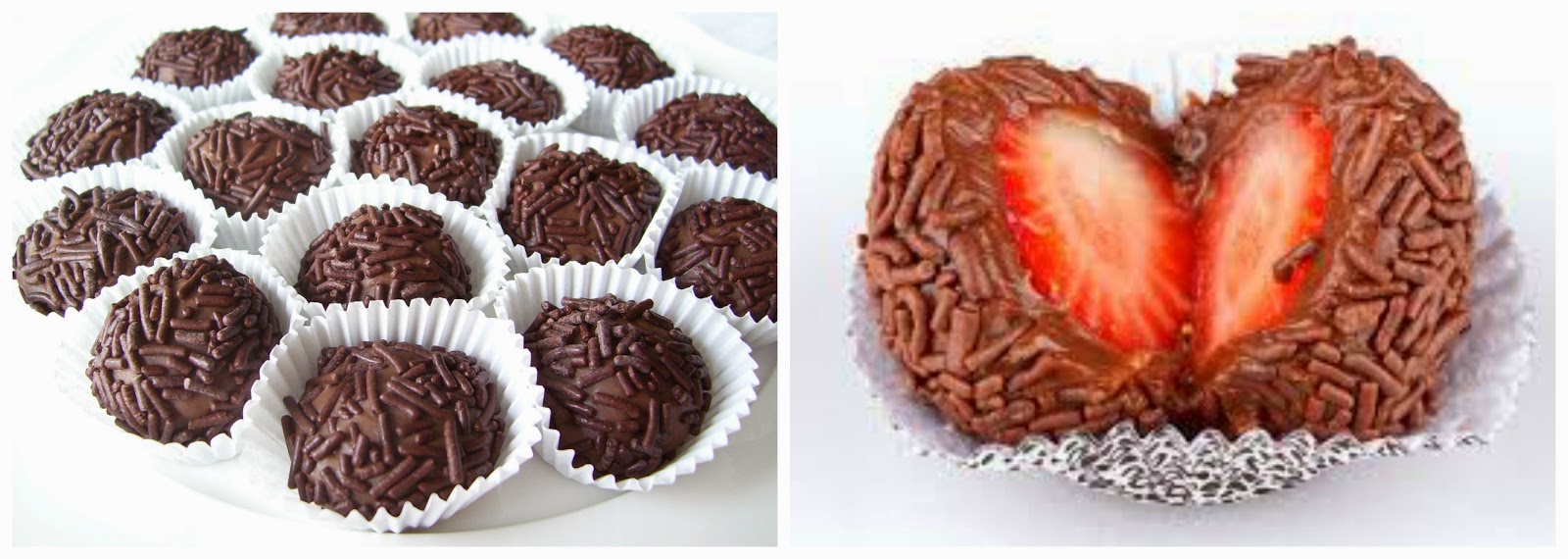
19. Brigadeiro (dessert): Chocolate truffles made with condensed milk instead of cream, chocolate powder and covered in chocolate sprinkles. Most commonly in bakeries, confectioneries and candy stores.
20. Romeu e Julieta: Guava paste and white cheese stacked on top of each other or separeted.

21. Caipirinha: It's the national cocktail of Brazil. It is made with lime slices, sugar and “Cachaça” that is a popular sugarcane derived of alcohol. Some prefer to substitute the cachaça for vodka, which in some areas of Brazil is called a “Caipiroska”. Once it is the national drink, you will find a Caipirinha in every bar or restaurant in Brazil.

22. Guaraná: Pronounced “gware‘na”. Guaraná is one of the most popular soft drinks in Brazil. Guarana is made from a fruit that grows in the Amazon jungle. The guarana fruit is rich in natural caffeine and used in many energy drinks.
Guaraná
23. Suco de Cajú and its alcoholic brother, cajú amigo: Brazil is blessed with many delicious and nutritive fruits, and the bright yellow cajú (pronounced kah-juh) is among the local favorites. Its juice is bittersweet and amazingly tasty, and if you ever cross paths with the picolé (popsicle) version, get one. Cajú amigo is a batida (shaken cocktail) made with a local liquor like cachaça (sometimes vodka) with ice, sugar, and the crushed fruit.
 Cajú Juice
Cajú Juice

Cajú amigo (cocktail drink)

You might like to see the other post titled: Interesting facts about Brazil

Sunday, June 16, 2013

Amazonas - Biodiversity


Over the past millennium  geological and climatic changes undergone by the Amazon were decisive for the evolution of plant and animal species that originally inhabited the region. Due to these transformations the rich biodiversity in the Amazon rainforest, which, next to what remains of the Atlantic Forest, placing Brazil among the countries most well endowed in this regard. Holds the largest tropical vegetation on the planet, the Amazon is exuberant manifestations in life, from microscopic to giant. Bathed in intense light, it practically heats evenly throughout the four seasons, and fed by a complex hydrological system, the Amazon daily promotes its own renewal, an endless cycle that alternates in life and death, day and night, rain and sun, ebb and flooding of rivers, beneficially influencing the climate on a global scale.

This happy conjunction millennial result the flavors, smells and colors of Amazonian fruits, odd, that the waves of globalization, become known worldwide. The traditional wine (juice) of the riparian Amazonian açai is gaining admirers and enthusiasts from all over the world because of its high nutritional properties. The Amazon rainforest, which has its core most representative in the State of Amazonas, has over the years increasingly revealing its potential for generating wealth, we can highlight the cocoa, cinnamon, vanilla (intensively exploited during the colonial period) , rubber tree, balata, guaraná; Mirantã; cassava, camu-camu, cupuaçu, rosewood, cumaru, andiroba; copaíba; sorva, and Brazil-nut, besides valuable woods, such as mahogany, cedar, cherry, itaúba and angelim. Without discrediting the beauty of orchids and Alanas (water lilies), the queen among Amazonian plant is portentous sumaumeira (kapok tree), giant that reaches 60 meters (the equivalent of a 20-story building), with a base circumference of more 20 yards and a umbrella that exceeds 100 meters in diameter.

Cassava

Mirantã (aphrodisiac - it's said that it's a natural viagra)


Sumaumeira (kapok tree),the queen among Amazonian plants. Photo Clednews


Water Lily (Vitória-Régia) Photo by Marijan Murat/AFP

Contrary to what many people think, this beautiful flower Amazon does not float freely. It is attached to the bottom of rivers by thick roots, buried in the mud, give support to the stem. Leave it long and thorny stems. "The spines serve to ward off predators. Finally, the lilypad is a juicy food for fish and aquatic mammals," says the botanist João Semir, Unicamp. Underwater leaves remain closed. Then open shaped trays, which can reach 2 meters in diameter. Its underside has a network of veins and air-filled compartments that give special plant resistance. And there is strength: there are records of leaves that support up to 45 pounds of weight! The flowers, fragrant with many petals are white to emerge. Once pollinated by insects, are rosy. The water lily is native to the equatorial regions of northern Brazil, Bolivia and Guyana.

In the endless list of plant species adds to the animals, especially the jaguar, puma; 'airuvê' (Manatee), tapir (the largest land animal in South America), capybara (the largest rodent in the world); 'amana (red dolphin); ´'tucuxi' (gray dolphin); 'ariranha'; 'uacari' white and pied-toed, plus a kilometric list of fish, among which stand out for arapaima fish (largest fish freshwater in the world); 'pirarara' (catfish); 'tambaqui'; 'tucunaré', even the humble and tasty 'jaraqui' is responsible for feeding a good portion of the population. There are also giant reptiles (the adjective is recurrent) as the constrictor anaconda, which exceeds 10 meters, black caiman, and the boa constrictor; beyond   very poisonous surucucu-peak-of-jackfruit, alligator-tinga, turtles of -Amazons; 'tracajá'; turtle, and iguana. Wonderful birds populate the largest Brazilian state, as the cock-of-the-hills; 'uirapuru'; macaw; 'cigana' (gypsy); toucan, and the magnificent Uiraçu (eagle hawk), absolute master of the Amazon's skies, whose scale exceeds two meters, which makes it the largest bird of prey in the planet.


Jaguar

snakes


blue macaw. Photo by Marília Mag

'Cigana" (gypsy)

parrot


Parakeet. Photo Flickr by Dan's World of Pictures


Two beautiful macaws

cock-of-the-hills
Uirapuru. Photo Flickr by Coppede
Toucan. Photo Flickr by Dan's World of Pictures

Uiraçu (eagle hawk), absolute master of the Amazon's skies
                              Iguana. Photo Flickr by Rob Dyett

Culture

The Amazon contains a surprising cultural diversity even for its own inhabitants, arising mainly from their ethnic background, where the indigenous element was gradually absorbing the African and European influences, particularly Portuguese and Spanish, and other migratory currents that contributed to the crucible Amazon. Hence the  Amazon people reflect in their culture the manifestations as distinct from each other as the ritual of the 'Moça Nova' (New Girl), performed in the upper Solimões River, Amazonas Opera Festival, presented in sumptuous Amazonas Theater in Manaus, and street carnival, which takes place virtually in all municipal seats.
Ritual of the 'Moça Nova', performed by Wotchimaücü indians.
This type of culture is traditional among some indigenous peoples, including Tikuna, and takes up to a year to be prepared. The goal is to celebrate in the best way possible, the first period of a young Indian. Photo by  Isaac Júnior (Divulgação/Seind)
Amazonas Theater in Manaus. Foto Flickr by Barbara Nonato

Photo : governo do amazonas

Photo Flickr by SpecBR

With its symbolic reference rooted in three distinct ethnic matrices together, the Amazonian translates this symbolism exuberantly during Parintins Folklore Festival, with the dueling bumbás at a party of explosion of colors, sounds and rhythms in which the rich mythology Amazon turns into storylines and choreography that attracts and delights people from all parts of the world. This folkloric manifestation is increasingly committed to the ecological aspects involving the conservation of the Amazon as a whole, and particularly the Amazon, a State that has one of the most pristine forests of all who make up the region.

Parintins Folklore FestivalPhoto:  Antônio Salani

The cultural reference Amazon also manifested in crafts, in which raw materials harvested sustainably from the Amazon Rainforest are transformed into decorative and utilitarian objects, such as baskets fiber 'arumã' from the upper Rio Negro, and for personal use such as rings , bracelets and necklaces made ​​from 'jarina' seeds.

Crafts - personal use


Due to increasing contact with elements from other cultures,  Amazon people come realizing their own uniqueness and of the cultural richness that is their mythology, traditions and customs, so that these aspects are being harnessed as tourist attractionsRituals virtually unknown to the local urban population became part of the calendar of events Amazon. The 'Tucandeira', for example, was once only practiced as a rite of passage between childhood and adolescence, now takes on a welcome element that generates income for members of some Amazonian communities from ethnic 'Saterê-Maué'. Thus, as an essential element in the composition of identity, the Amazon culture  has been renovating itself and adapting to the times of globalization, without, however, losing its essence and dynamism.

Among the indigenous rituals, what stands out most is the ritual of the tribe 'sateré-mawé' named 'Tucandeira'. This event is held as a form of male initiation. All the guy wants to be "man" has to go through this stress test that consists of being stung by hundreds of angry big ants! The Indians sateré-mawé to prove their strength, courage and masculinity should be left stung at least 20 times, putting his hands inside the glove Tucandeira (saaripé). Some say it should be with the hands to be stung  for 10 minutes.


Search: http://www.amazonas.am.gov.br