Showing posts with label Açai. Show all posts

Monday, September 21, 2015

Belém, Capital of Pará State

Belém, streets lined with mangos trees

Belém is a Brazilian municipality, the capital and largest city of the state of Pará in the country's north. This is an important destination, as it acts as the gateway to the majestic Amazon River, which remains one of the world’s greatest tourist attractions and with a busy port, airport, and bus/coach station. It is the second largest city in the North Region, second only to Manaus, in the state of Amazonas.

The city of Belém is modern, but retains much of its historical charm and beauty. Many of the main streets are lined with trees, while the city center is bustling with tall buildings and the hubbub of a thriving metropolis.

The sloping central park is quiet during the week and bustling on weekends, when locals come out in masse for free performances and tasty street food. Nightlife tends toward the bohemian intellectual sort: art-house theaters, small music venues, heady cafe-bars.

Belém, literally Bethlehem is also known as the Metropolis of the Brazilian Amazon region or the Cidade das Mangueiras (City of Mango Trees) due to the vast number of those trees found in the city. Brazilians often refer to the city as Belém do Pará ("Belém of Pará") rather than just Belém, a reference to an earlier name for the city, Santa Maria de Belém do Grão Pará, and also to differentiate it from a number of other towns called Belém in Brazil. It is named after Santa Maria de Belém in Lisbon, also better known by its shortened name, Belém.

The capital of Pará is full of indentations and recesses forming islands all around it. There are 55 of these islets, most of which are wild and uninhabitable, although some are home to small populations called ribeirinhos.

These include the islands of Mosqueiro, fringed by 14 freshwater beaches, and Caratateua which receive a large number of visitors in summertime. In addition to these and also near Belém, is the island of Tatuoca which is the location of one of the seven geophysical stations in the world, and the only station in Latin America.

Today, the most important exports coming out of Belém are aluminium, iron, nuts, wood veneers, hardwood, pineapples and cassava, amongst others.
The climate of Belém is typically tropical, with rain, heat and humidity all year around. There are certain months that are wetter than others (namely December to May), but there is no dry season. Daily high temperatures average around 26 degrees Celsius (or about 79 degrees Fahrenheit) all year around. This climate creates the ideal environment for tropical rainforest vegetation to abound, giving the city a really beautiful aesthetic aspect.

The Ver-o-Peso (Portuguese: "see the weight") market in the old port center is a major tourist attraction.

Interestingly, Belém has a huge Indian cuisine culture. This is a favourite amongst locals as well as international tourists. The local Amerindian culture extracts colors, scents, flavors, and native tastes from nature to produce a rich and exotic cuisine, adding up to the most authentic of regional cuisines. One such dish, "Cupuaçu", comes from the Cupuaçu tree, found in the Amazonian woods. Cupuaçu is easily identified by its smell and sour taste and is highly appreciated by both locals and tourists. Its pulp is also extracted to make juices, candies, jellies, liquors, and ice cream. Açaí is a palm tree with a long, thin stem. Açaí, also known as Jussara, is purple in color with a delicious taste. Long prized by the local population, it recently it has also reached the national menu.
Cupuaçu
Freshwater crab, a traditional local delicacy, is a very popular dish in the city's cuisine. Found only in swamps, its well-tempered meat can be served in different forms: as a shell, the so-called unha (the claws) or toc-toc. "Maniçoba" is one of the highlights of the local cuisine. Its preparation is time-consuming and its final appearance is quite surprising for those who have never tried it, due to the dark look of the cooked maniva (ground manioc leaves). But this first impression ends quickly, after you taste the dish with its seemingly awkward ingredients. Maniçoba is often served in ceramic dishes, and can be eaten with rice or with manioc flour and capsicum.

Popular tourist attractions here include:


The Amazon Biopark Zoo – surrounded by jungles and rivers, the fauna and flora in this natural area are a true wonder. Located less than 15 kilometers from the center of Belém, in the Tenoné neighborhood.

The Rodrigues Alves Wood–Botanic Garden – Inspired by the Bois de Boulogne Park in Paris, it is a little piece of Amazonia preserved in the middle of the city. It has 2,500 native species, an orchidary, lakes, caverns, waterfalls and even a replica of a mountain. 

The Ver-o-Peso Market – Created in 1688, as a result of the Portuguese deciding to levy a tax for everything entering and leaving Amazonia. Despite resembling a large retailer, the mixture of colours, fragrances and objects is very interesting as well as folkloric. A variety medicinal herbs, various regional fruits, arts and crafts, domestic utilities, meats, fish and seasonings and spices can be found there. The Market brings together two thousand stalls and traders in every part and is located near to the old Mercado de Ferro (Iron market), on the quays.

The Estação das Docas Complex: It reopened the windows of Belém to Guajará Bay. The restoration project covers the area of old warehouses of the Pará Docks Company. Constructed from prefabricated metal structures in England and that were built at the beginning of the twentieth century in Belém. There are 18 thousand square meters of urbanized area, with coffee bar services, various restaurants, stores, travel agencies, banks, in addition to an auditorium and two memorials: The Porto Memorial and the Fortaleza de São Pedro Nolasco Memorial. There is, also, a fluvial station and extensive external area.
The Goeldi Museum 
Cidade Velha is an old part of the city that boasts beautiful French architecture. 
The Mangal das Garcas Park
Forte do Presepio
Algodoal Island
Catedral da Se
Emilio Goeldi Museum
• Mosqueiro: The river island of Mosqueiro, 67 km (42 mi) north of the heart of the city, attracts beach tourists in the dry season.

The Estação das Docas Complex. Photo: inspiringadventures
 
Photo: wikimedia by Cayambe. The Docas Complex

Belém, Teatro Paz (theater). Photo: wikimedia by Celso Roberto de Abreu Silva
  
Ver-o-Peso Market

Belém, Icoaraci. Photo by Rui Santos via Panoramio

Açai berries. Close to the fort of Castelo is the site of the Feira do Açaí, a market supplied by boat with the fruits of the açaí palm, a common local tree, which are used in the making of ices and fruit drinks. Photoplanetware

Carimbó it is a circle dance of the coast of Pará, Brazil. The name also applies to drum used in this dance style.The most extraordinary manifestation of artistic creativity of Pará people was created by the Tupinambá Indians who, according to historians, were endowed with an unusual artistic sense, coming to be considered in the tribe, as true demigods. Photo: agenciapara

Distant 50 Km of Belém do Pará, Mosqueiro is the portal of one of the prettiest freshwater beaches in Brazil. Photo: Natal Jordão vy panoramio

Mosqueiro Island, freshwater beach.

Belém is home to a part of the Amazon in Mangal das Garças, set on the banks of the Rio Guamá, in the historic center of the capital. The site is a revitalized ecological park, occupying an area of 40,000 square meters in the vicinity of the Navy Arsenal. Photo: Reprodução guiadasemana

Mangal das Garças Park

The Amazon Biopark Zoo. Photo: holidaycheck

The Rodrigues Alves Wood–Botanic Garden. Photo: juremajosefa

Search: wikipedia and brazilorg

Saturday, February 7, 2015

Brazilian fruits: A unique flavor!

I  showed here before some Brazilian fruits, read it at this post. Today I want to add more to this extensive list, that I wish everyone would have a chance to taste it. You would be surprised to know how delicious it are! But these are not all!!
And remember: when you go to bars, restaurants and food courts you are served with natural fruit juices (most the times squeezed from the fruit right away and sometimes from frozen fruits' polps).

ARAÇÁ: The fruits are rounded berries, green or yellow (there are red varieties), crowned by the persistent calyx, whitish juicy pulp, similar to a small guava and bitter taste.

ARAÇÁ

FOUR DIFFERENT KIND OF BANANAS


CACAU: The fruit has a thick yellow skin when ripe, and needs to be broken with some force to open. Inside, the seeds are surrounded by a white pulp acid flavor, harnessed to sweets and juices. From the seed or almond it's extracted the cocoa powder, bitter taste, which is the basis for the making of chocolate. Therefore, the almonds are dried, roasted and ground.

CACAU (COCOA FRUITS)

PINHA: Annona squamosa is a small, well-branched tree or shrub from the family Annonaceae that bears edible fruits called sugar-apples. The flesh is fragrant and sweet, creamy white to light yellow, and resembles and tastes like custard.

PINHA (PINECONE, or ANNONA SQUAMOSA )

GOIABA: Guava fruits, usually 4 to 12 centimetres (1.6 to 4.7 in) long, are round or oval depending on the species. They have a pronounced and typical fragrance, similar to lemon rind but less sharp. The outer skin may be rough, often with a bitter taste, or soft and sweet. Varying between species, the skin can be any thickness, is usually green before maturity, but becomes yellow, maroon, or green when ripe. The pulp inside may be sweet or sour, and off-white ("white" guavas) to deep pink ("red" guavas). The seeds in the central pulp vary in number and hardness, depending on species.

GOIABA (GUAVA)

MANGA: Mangoes are generally sweet, although the taste and texture of the flesh varies across cultivars; some have a soft, pulpy texture similar to an overripe plum, while others are firmer, like a cantaloupe or avocado, and some may have a fibrous texture.

SOME TYPES OF MANGO


CAMBUÍ: The pulp has great potential to be used to make jellies, ice cream and juices. The ripe fruit is a round or slightly elongated berry, up to 20 mm wide and 25 mm long. It has a thin purple-black skin and a wet, firm, whitish pulp about 3–5 mm thick, surrounding a loose single (rarely double) seed. It is edible, moderately sweet, with an aroma similar to (but less intense than) that of the jabuticaba.

CAMBUÍ DO CERRADO 

CAJÁ: The cajá is a tree-fruit, and one of the problems in commercial cultivation is the height of the tree - often more than 100 ft. (30 m). Nonetheless, it's extensively cultivated and highly appreciated in Brazil, particularly in the Northeast and in the state of Bahia. The fruit itself is about 5 cm (2 in.) in length, and has a leathery skin, a thin layer of pulp, and a large, hard pit. Cajá is most often processed than eaten raw, and is valued as juice, jelly, and flavoring for ice cream, yogurt, etc. One of the most delicious ways to sample cajá is in a caipifruta, an alcoholic drink derived from the caipirinha. It's like a combination of apricot and mango (with a slightly resiny taste), but with jacked-up acidity, like a mild passion fruit.

CAJÁ

CAMAPÚ: The genus is characterized by an orange fruit is small, similar in size, shape and structure of a tomato, but partially or completely surrounded by a large shell which derives from the whorl. Fruits are beautiful. They are small and round, with color ranging from yellow to red. But what most delights in Physalis is the cup which naturally involves: a thin, delicate yellow capsule, similar to rice paper, recalling the design of a small flashlight. Contains high levels of vitamins A, C, phosphorus and iron, as well as flavonoids and phytosteroid. Its flavor is unique, slightly acidic and sweet.

CAMAPÚ (Physalis angulata)

COCONUT FRUIT: Coconuts are different from any other fruits because they contain a large quantity of "water" and when immature they are known as tender-nuts or jelly-nuts and may be harvested for drinking. Botanically, the coconut fruit is a drupe, not a true nut.

CÔCO (COCONUT)

ATEMÓIA: Similar to Pinha, is a hybrid of two fruits – the sugar-apple (Annona squamosa) and the cherimoya (A. cherimola) – which are both native to the American tropics. An atemóia is normally heart-shaped or rounded, with pale-green, easily bruised, bumpy skin. Near the stem, the skin is bumpy as it is in the sugar-apple, but become smoother like the cherimoya on the bottom. The flesh is not segmented like that of the sugar-apple, bearing more similarity to that of the cherimoya. It is very juicy and smooth, tasting slightly sweet and a little tart, reminiscent of a piña colada. The taste also resembles vanilla from its sugar-apple parent.

ATEMÓIA

GRAVIOLA: is the fruit of Annona muricata, a broadleaf, flowering, evergreen tree.The pulp is also used to make fruit nectar, smoothies, fruit juice drinks, as well as candies, sorbets, and ice cream flavorings.The flavour has been described as a combination of strawberry and pineapple, with sour citrus flavour notes contrasting with an underlying creamy flavour reminiscent of coconut or banana.

GRAVIOLA (SOURSOP)

MARACUJÁ: The passion fruit is round to oval, either yellow or dark purple at maturity, with a soft to firm, juicy interior filled with numerous seeds. The fruit is both eaten and juiced; passion fruit juice is often added to other fruit juices to enhance aroma.

MARACUJÁ (PASSION FRUIT)

SERIGUELA: The fruits are often eaten ripe, with or without the skin. It is sometimes eaten unripe with salt and vinegar or lime juice.This vitamin-packed fruit is a small and round or oval, with a yellow-orange skin that is often mottled with red. It's most commonly eaten as-is, raw, and that's the way I like it best. During the harvest season, vendors sell seriguelas from carts throughout the city, and at traffic lights, people sell net bags of seriguelas to drivers and passengers in the cars waiting for the light to change.The seriguela is a well-loved fruit in the northeastern part of Brazil, and its season rolls around in mid-summer (December to February south of the equator). The soft skin surrounds a not-too-sweet but very aromatic pulp that melts in the mouth and is very juicy. The flavor has hints of mango and cajá, which is not surprising as these three fruits are all from the same botanical family. In the center of the fruit is a single seed that takes up at least half of the volume of the fruit, but which is surprisingly light.

SERIGUELA


UMBÚ: The flesh is soft and juicy, with a sweet taste and distinct aroma. The fruit comes from a small tree, seldom higher than 6 m, with an expansive crown of up to 10 m in diameter. The fruit of the Umbu are round and can be of varying size: they can be as small as cherries or as large as lemons. The peel is smooth and green or yellow when the fruit ripen, the small firm fruits are juicy and flavorful and their succulent flesh hides a large dark pit. When fully ripe the flesh is soft and juicy, with a sweet taste and distinct aroma.The fruit are sour if eaten before they are fully ripe.

So, if and when you come to Brazil's Northeast during umbu season (December-March), search them out. It's an exotic local treat that you won't find anywhere else.

UMBÚ(Spondias tuberosa)

MANGABA: The fruit is oval and berry-shaped, yellow or greenish in color, sometimes with red pigmentation. When ripe it has a yellow skin with reddish marks, and a very aromatic, delicate smell. The flesh is soft, white, slightly viscous and fibrous, with a unique sweet flavor. The native people, who know the fruit well and used it widely, called it mangaba, which means "good fruit for eating". 
As well as being very popular as a fresh fruit, mangaba is also used for making juices, ice creams, jams, pastries, preserves, distillates, and wines and syrup.

MANGABA

 
AÇAÍThe açaí berry is an inch-long, reddish-purple fruit. It comes from the açaí palm tree, which is native to Central and South America. Some studies show that açaí fruit pulp is even richer in antioxidants than cranberries, raspberries, blackberries, strawberries, or blueberries.
The açaí berry in its natural state, just as it comes off its palm tree, is not a very appetizing fruit. The berry consists of a very dark purplish-black skin covering a thin layer of light-colored flesh and a large inedible seed. The fruit has no natural sugars, and so the taste isn't fruit-sweet; it's earthy, some would even say dirty, dense and dark.
In the Amazonian rain forest where the açaí palm grows, hose who dwell along the banks of the numberless rivers and streams do eat the berry in this natural state, but outside that region almost no one does. The principal reason is that the açaí berry in its natural state is extremely perishable and fragile, so it's not practicable to store it or transport it. Consequently, the seed of the berry is extracted shortly after harvesting and the remaining flesh and skin are pulped together, then flash-frozen. It is this frozen pulp which is the basic, commercially viable, açaí from which all açaí products are made - from juices, to syrups and on to ice creams, salves and even vodkas.

AÇAÍ

ACEROLA:  After three years, trees produce significant numbers of bright red drupes 1–3 cm (0.39–1.18 in) in diameter with a mass of 3–5 g (0.11–0.18 oz). Drupes are in pairs or groups of three, and each contains three triangular seeds. The drupes are juicy and very high in vitamin C and other nutrients. They are divided into three obscure lobes and are usually acidic to subacidic, giving them a sour taste,but may be sweet if grown well.The vitamin C produced by the fruit is better absorbed by humans than synthetic ascorbic acid.

The resemblance between acerola and cherries is obvious, although the red of acerola is more orange than the purplish red of most cherries.

Acerola has an extremely high ascorbic acid (Vitamin C) content - acerola juice has over 3000% more Vitamin C than an equivalent amount of orange juice. That's not a typo - it's 3000%higher. It's claimed that by adding a very small amount of acerola juice to another juice that is low in Vitamin C (apple juice, for example), the levels of the vitamin in the juice will rise to the level found in orange juice. A Brazilian agricultural research agency recently prepared a study of the antioxidant property of eleven varieties of frozen fruit pulp, and in that study found acerola to have significantly high antioxidant properties.

Acerola juice is naturally very sour, which is logical considering the high Vitamin C content, and to be drinkable, some quantity of sugar must be added.

ACEROLA

JABUTICABA: The fruit is grape-like in appearance and texture but with a thicker, tougher skin.The gelatinous whitish pulp contains from one to four small seeds and has a pleasant, subacid flavor markedly similar to certain muscadine grapes. Fresh fruit is delicious eaten out-of-hand and can be made into jellies, jams and wine. Jabuticaba grows on a large deciduous tree, which can reach 8-10 meters (25-25 feet) in height. The fruit grows directly from the trunk and branches of the tree, which gives the jabuticaba tree a very unusual appearance when in fruit. The fruit itself is a small and round, about the size of a table grape and it has a deep purple color.

The fruit is high in beneficial antioxidants, and has high levels of iron. In traditional indigenous medicine, jabuticaba juice is given to pregnant women, which aids them because of its high iron content. Also a tea made from the dried skins of jabuticaba is used in traditional medicine as a treatment for asthma, diarrhea and is gargled to alleviate sore throats.

JABUTICABA


Monday, January 12, 2015

23 Traditional Brazilian Foods, desserts and drinks that you may like to try

Brazilian food is a big part of the country’s culture — it blends together flavors from all over South America as well as Portugal, Spain (countries that colonized the continent and left their marks on the culture, cuisine, and language), and Africa (many African slave were brought over to work in the plantations and brought many local flavors with them). The combination of native dishes with the immigrant-influenced flavors, and those continental influences make Brazilian food unique, complex, and deliciously rich.

Brazilian food is generally rich and spicy. Much of it is either fried or slow-cooked to bring out the flavors. Palm oil is often used for the frying and coconut oil is added to bring all the flavors together. 

1. Feijoada: A black bean stew with various types of beef and sausage. It's often referred to as the national dish of Brazil, so you should try it at least once when you visit the country. In some parts of the country, they also add vegetables like cabbage, kale, potatoes, carrots, okra, pumpkin, and sometimes even banana. These are often added at the end of the cooking process so the juices from the stew can infuse them without making them limp. Everywhere! Its generally served as the main dish in many restaurants on wednesdays and saturdays.

2. Churrasco: in Brazil it simply refers to a barbecue, which is almost comprised of large chunks of meat cooked on skewers. When in Brazil you may want to visit a "churrascaria", a restaurant that has all-you-can-eat barbecued meat, sometimes served with other kind of meets such sausages. In every city you can find many "churrascarias", with all price ranges. Churrasco is the traditional food in the South region of Brazil.


3. Moqueca de Camarão or Fish: A shrimp or fish stew cooked in coconut milk and palm oil. Add veggies such as peppers and tomatoes to complete. It's one of the country’s most famous dishes. It´s a traditional dish in Bahia, Espirito Santo and Pará.

4. Vatapá: It's a creamy but fragrant dish made from shrimp, bread, and a special paste made from finely ground peanuts, palm oil and of course, coconut milk. It’s often eaten with white rice or acarajé.

5. Acarajé: The famous "bolinho" of the Bahia is popular throughout the country. A black-eyed pea ball fried in palm oil, usually stuffed with shrimp and vinaigrette or vatapa. It's a typical dish of Bahia. In Salvador city, it's the most common street food.

6. Arroz e Feijão: Traditional every day dish. You can find everywhere (rice and beans).

7. Farofa: Fried cassava flour. It can include egg, bacon, and other add-ons. It’s usually sprinkled over rice and beans. It's a traditional national dish, served as a side dish almost everywhere.

8. Feijão Tropeiro: Pinto beans sautéed with cassava flour, scallions, egg, and torresmo (crispy fried pork rinds).Typical dish of Minas Gerais but also of Bahia and some other States.

9. Tucunaré and pirarucu: It's not surprising that the Amazon, being the largest river system on the planet, has plenty of delicious fish to offer. These two giants (pirarucu can weigh 200kg!) are every fisher’s favorites and are easy to find while traveling in the north. They’re firm, white, meaty, succulent, and can be filleted, stuffed, or baked whole.

10. Tacacá: A traditional hot soup made of tucupi (manioc sauce), tapioca (manioc flour), and dried shrimp, plus a green leaves known as jambu, which has a numbing or tingling effect on the mouth. The dish is served in bowls and is very easy to find in Amazon cities, northern restaurants, and food stands all over the northern States.

11. Cuscuz Paulista: Mixing two of the most popular Brazilian ingredients (corn and manioc flour), cuscuz comes in many variations, the Paulista being the most famous. It’s basically a salty cake-like recipe made with flour and filled with ingredients that can vary from canned sardines (yes!) to palm hearts, boiled eggs, tomatoes, and olives (often all together). Every family has its favorite recipe.

12. Pão de Queijo: Little, fluffy balls of manioc flour bread with cheese baked in it. It’s said that the best come from Minas Gerais, but they’re famous in São Paulo and Rio de Janeiro too. The cheese bread is a typical food of Minas Gerais, which spread throughout Brazil. And it is so popular in the country that there are large networks that have built their brands on top of cheese bread.

13. Coxinhas: Deep-fried dough usually filled with chopped chicken breast and a very creamy cheese called "catupiry". It’s available everywhere and best enjoyed with a can of the Brazilian soda Guaraná. Everywhere: in restaurants, as appetizer; bars, bakeries.

14. Açaí: In North America it’s a new “wonder berry,” but Brazilians have known about this little purple delicacy for ages. A superfood berry used to make fruit bowls and smoothies. Pro tip: Blend with bananas and strawberries and top with granola and honey.

15. Pastéis: fried goodness with less dough, which you can fill with everything from cheese, to beef, to cod fish, and pretty much whatever else your stomach desires.Here in Brazil pastel often replaces a full meal, the amount of such fillings and sizes that can be found. Are usually accompanied by sugar cane juice.

16. Bolinho de Bacalhau: a cod fish cake in a ball shape (Deep fried cod fish in potato dough). Commonly offered as an appetizer in many bars and restaurants.

17. Tapioca: kind of pancake made from manioc starch and water, used for different types of meals. In beiju (or biju), the tapioca is moistened, strained through a sieve to become a coarse flour, then sprinkled onto a hot griddle or pan, where the heat makes the starchy grains fuse into a flatbread, which may be sprinkled with coconut. Then it may be buttered and eaten as a toast (its most common use is as a breakfast dish), or it may be filled or topped with either salgados (savory ingredients) or doces (sweet ingredients). Tapioca is more traditional and easier to find in the Northeast of Brazil, in many bars and restaurants, also as street food. In other regions, is more common to find it as street food.

18. Mousse de Maracujá (dessert): Passion fruit mousse. Mousse de maracujá or passion fruit mousse is a delicious and easy to make dessert. This tropical mousse is made with passion fruit pulp, whipping cream or condensed milk, egg whites and sugar. This South American dessert is very popular in Brazil!


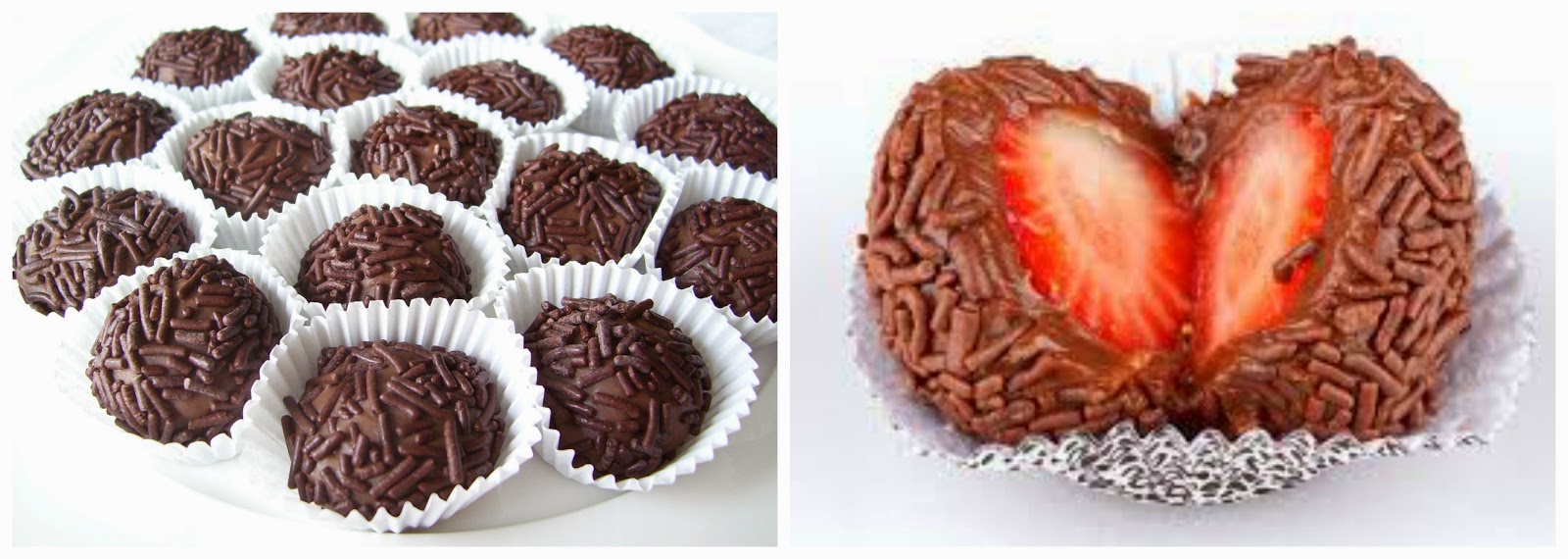
19. Brigadeiro (dessert): Chocolate truffles made with condensed milk instead of cream, chocolate powder and covered in chocolate sprinkles. Most commonly in bakeries, confectioneries and candy stores.

20. Romeu e Julieta: Guava paste and white cheese stacked on top of each other or separeted.

21. Caipirinha: It's the national cocktail of Brazil. It is made with lime slices, sugar and “Cachaça” that is a popular sugarcane derived of alcohol. Some prefer to substitute the cachaça for vodka, which in some areas of Brazil is called a “Caipiroska”. Once it is the national drink, you will find a Caipirinha in every bar or restaurant in Brazil.

22. Guaraná: Pronounced “gware‘na”. Guaraná is one of the most popular soft drinks in Brazil. Guarana is made from a fruit that grows in the Amazon jungle. The guarana fruit is rich in natural caffeine and used in many energy drinks.
Guaraná
23. Suco de Cajú and its alcoholic brother, cajú amigo: Brazil is blessed with many delicious and nutritive fruits, and the bright yellow cajú (pronounced kah-juh) is among the local favorites. Its juice is bittersweet and amazingly tasty, and if you ever cross paths with the picolé (popsicle) version, get one. Cajú amigo is a batida (shaken cocktail) made with a local liquor like cachaça (sometimes vodka) with ice, sugar, and the crushed fruit.
 Cajú Juice
Cajú Juice

Cajú amigo (cocktail drink)

You might like to see the other post titled: Interesting facts about Brazil